













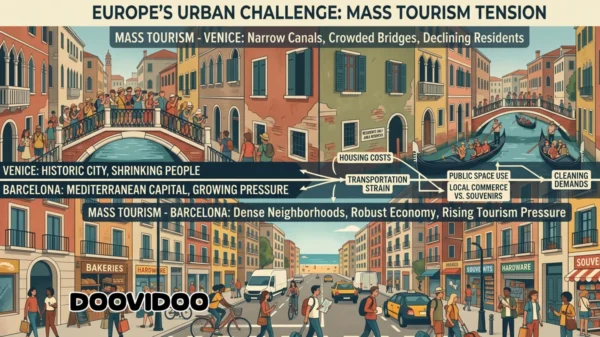






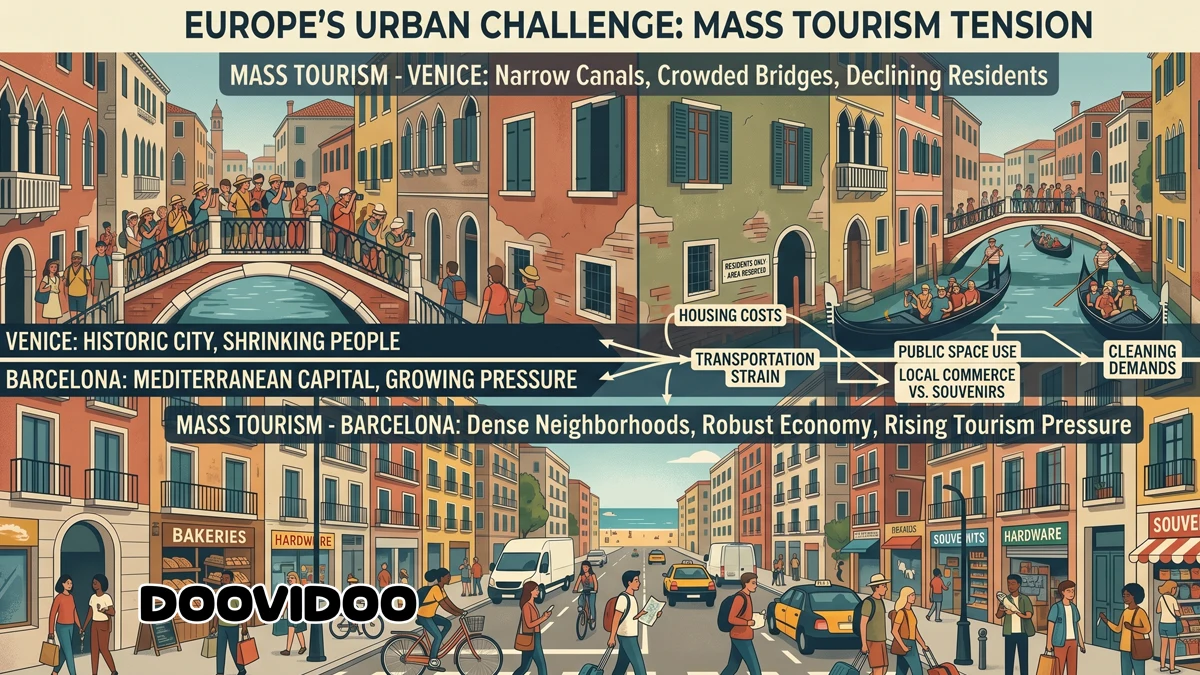
Mass tourism is no longer a distant debate for major European cities. It is a daily tension between visitors, residents, housing, transportation, cleaning, local commerce, and public space. Venice and Barcelona show the same problem from two different realities. One is a historic city with narrow streets, canals, and a shrinking resident population. The other is a Mediterranean capital with dense neighborhoods, strong economic activity, and tourism pressure that grows every year.
Tourism generates income. It also supports hotels, restaurants, guides, shops, and jobs. But when volume exceeds urban capacity, the city changes its function. The center stops serving residents first. Rent rises. Commerce shifts toward visitors. Streets become crowded. Transportation loses comfort. Daily life becomes more expensive.
For this reason, mass tourism has entered a new stage. Municipal authorities no longer limit themselves to promoting destinations. They now apply taxes, limit groups, reduce tourist rentals, and seek to slow down day tourism. Venice charges an access fee on high demand days. Barcelona raises tourist taxes and moves against short term tourist apartments.
The shift is clear. Cities want visitors, but they also want to regain control.
What Mass Tourism Means
Mass tourism happens when a city receives a number of visitors beyond its social, urban, and environmental capacity. The problem is not measured only by annual arrivals. It also depends on concentration in a few neighborhoods, pressure on specific dates, and the type of visitor.
A tourist who stays three nights in a hotel contributes differently than a cruise passenger who enters for a few hours. A visitor who walks through the center without spending much in local services uses space, transportation, security, and cleaning. That difference explains part of the current debate.
Cities do not reject tourism. They reject imbalance. Mass tourism appears when the visitor displaces the resident as the center of urban policy.
Venice, the City That Charges to Enter
Venice is the most symbolic case. The city receives millions of visitors each year, but its historic center has a reduced resident population. Pressure concentrates on streets, bridges, squares, and access points. Day visitors represent a large share of the flow. They arrive, walk around, take photos, and leave. Their spending often remains below the cost they create for the city.
The Comune di Venezia applied an access fee for day visitors on specific dates. In 2026, the charge starts on April 3 and applies on selected spring and summer days, from 8:30 a.m. to 4:00 p.m. The system requires digital registration and an access code.
The fee has two levels. Visitors who pay in advance pay 5 euros. Visitors who pay late pay 10 euros. The measure does not apply to everyone. Residents, workers, students, children under 14, and visitors who sleep in the city are exempt, because overnight visitors already pay an accommodation tax.
The official goal is to organize access on days of higher pressure. The city wants some visitors to change dates or plan their arrival better. It also wants to obtain resources for urban services. Venice does not have a normal maintenance structure. Its costs rise because of its geography, heritage, and physical fragility.
The measure did not solve everything. European press reports indicate that the fee generated millions of euros, but it did not strongly reduce visitor numbers. Even so, it set a precedent. Venice turned urban access into a tourism management tool.
Barcelona, Strong Tourism and Housing Pressure
Barcelona faces another version of mass tourism. The Observatori del Turisme a Barcelona reported that Destination Barcelona closed 2025 with 26.1 million tourists. The city of Barcelona received 16 million, and the region received another 10.1 million. Direct tourist spending reached 14.041 billion euros.
The figures show the economic weight of the sector. They also show the scale of the challenge. Barcelona does not receive tourists only in summer. It has conferences, cruises, sports events, cultural trips, weekend stays, and tourist apartment stays.
The airport recorded more than 57.4 million passenger movements in 2025. The port also reached historic highs, with 4 million cruise passenger movements and 1.8 million ferry passenger movements. These data confirm that pressure does not come from one single channel. It comes by air, by sea, and through urban accommodation.
The conflict is felt in neighborhoods such as Ciutat Vella, Eixample, Gràcia, and Barceloneta. Residents see more suitcases, more noise, more turnover, and more businesses aimed at visitors. Mass tourism stops being a figure and becomes a daily experience.
Tourist Taxes as a Control Tool
Cities apply tourist taxes for two purposes. To raise resources and to modify behavior. In Barcelona, the tourist tax has become a central part of the political response.
Reuters reported that Barcelona doubled its tourist tax in 2026, reaching amounts of up to 15 euros per night, depending on the type of accommodation. Part of the revenue goes to housing. The decision connects mass tourism with the housing crisis. If visitors put pressure on the urban market, the city wants them to contribute to the solution.
The case of cruise passengers also creates debate. Mayor Jaume Collboni defended an increase in the tax on short stay cruise passengers. The municipal argument focuses on visitors who stay only a few hours in the city. Their presence burdens public space, but leaves less local benefit than other visitor profiles.
This approach marks an important difference. Tourism policy no longer measures only how many people arrive. It now analyzes how long they stay, where they spend, what infrastructure they use, and what cost they pass on to residents.
Tourist Apartments and Housing
Barcelona also targeted one of the most sensitive sources of mass tourism: tourist apartments. The city announced that it will not renew the licenses of more than 10,000 tourist use homes when they expire in 2028. The goal is to return units to the residential market.
The measure responds to a concrete pressure. Rent rose sharply over the last decade. Although tourist apartments do not explain the entire housing problem, they do reduce supply in high demand areas. An apartment aimed at visitors leaves the long term rental market. For a resident, that means fewer options and more competition.
The decision received legal support from Spain’s Constitutional Court in 2025, according to Reuters. That support gave security to the municipal strategy. It also sent a message to other cities. Mass tourism is not managed only with taxes. It also requires reviewing the accommodation model.
Venice and Physical Limits
Venice has an obvious physical limit. Its streets do not widen. Its bridges cannot absorb any volume. Its canals do not remove pressure from cleaning, security, and mobility. For that reason, the city also limited tourist groups.
Since August 2024, Venice has restricted guided groups to a maximum of 25 people. It also banned loudspeakers on tourist routes. The measure seeks to reduce noise, improve pedestrian mobility, and protect historic areas.
Mass tourism in Venice does not harm comfort only. It affects conservation. The city must protect stone, water, transportation, and heritage. Every excess accumulates.
The Economic Dilemma
Venice and Barcelona share a common tension. Tourism brings income, but it also increases costs. If a city reduces visitors sharply, it can affect jobs. If it does not act, it loses residents and quality of life.
The dilemma has no simple exit. Authorities seek to change the type of tourism rather than close the door. Longer stays. Fewer quick visits. More distributed spending. Less concentration in saturated areas. More respect for residents. Less extractive consumption of urban space.
Barcelona appointed a specific figure to lead this transition toward sustainable tourism. The city wants to move from adding visitors to managing flows better. That shift requires data, license control, transportation coordination, taxation, and rules for tourism activities.
The Resident as the Measure of Success
For years, tourism success was measured by arrivals, hotel occupancy, and spending. That metric is now incomplete. A city with record figures can also have tired residents, high rents, and displaced local commerce.
Residents must return to the center of evaluation. If a tourism policy increases income but pushes people out, the urban result fails. If the historic center fills with visitors and loses everyday services, the city weakens. If tourism employment grows with low wages and expensive housing, the benefit is poorly distributed.
Mass tourism forces cities to measure more things. Job quality. Access to housing. Cleanliness. Noise. Transportation. Neighborhood commerce. Use of public space. Resident satisfaction.
What Comes Next for Tourist Cities
Venice and Barcelona anticipate the path of other destinations. Access fees, nightly taxes, cruise restrictions, group limits, and reductions in tourist apartments will keep gaining space.
These measures do not seek to eliminate tourism. They seek to set conditions. Visitors will keep arriving, but with more rules and higher costs. Cities want tourism to finance part of its own pressure and respect clear limits.
Mass tourism is no longer solved with promotion campaigns. It is managed through urban policy. Venice and Barcelona show that the future of tourism will depend less on the number of arrivals and more on the ability to protect local life.
An attractive city needs visitors. But it also needs residents, schools, markets, possible rents, functional transportation, and streets that do not live in constant saturation. When tourism breaks that balance, it stops being an opportunity and becomes a burden.
The current challenge is not to receive more. It is to receive better.
Supporting data: the Observatori del Turisme a Barcelona reported that Destination Barcelona closed 2025 with 26.1 million tourists, 16 million in the city and 10.1 million in the region, with 14.041 billion euros in direct economic impact.
The official Comune di Venezia portal states that the 2026 access fee applies on selected days, from 8:30 a.m. to 4:00 p.m., with charges of 5 euros for advance payment and 10 euros for late payment.
Reuters reported that Barcelona doubled its tourist tax in 2026 and that part of the revenue goes to housing. It also reported legal support for the plan to eliminate tourist apartment licenses in 2028.