
























Home no longer means the same thing for millions of people. For decades, the dominant image was clear: a house of one’s own, a mortgage, separate rooms, a fixed address, a family dining table, and stability. That idea still exists, but it is moving further out of reach for young people, middle income workers, students, migrant families, older adults, and people living in expensive cities.
Unaffordable housing is redefining home. When buying a house becomes impossible and rent consumes almost half of one’s income, alternatives that once seemed marginal begin to appear: living in vans, sleeping in adapted vehicles, sharing apartments with strangers, renting tiny rooms, entering extreme coliving arrangements, or accepting unconventional shared spaces that mix housing, work, and community.
This change is not born only from a trend. The van life aesthetic on social media shows sunrises, freedom, mountains, and roads. But behind many vans there are also unaffordable rents, insufficient wages, debt, lack of credit, and fear of being pushed out of the market. The same happens with coliving. It can sell community, flexibility, and design. It can also be a private response to a public crisis: there are not enough affordable homes in the cities where jobs exist.
Home stops being property and starts becoming an arrangement. A temporary agreement. A bed. A safe parking lot. A locker. A shared kitchen. An app to reserve spaces. A network of people sharing costs. The question is no longer only where a person lives. The question is what a person can call home when the market denies them stability.
Traditional Ownership Out of Reach
The redefinition of home begins with an economic reality. Buying housing requires more income, more savings, and more access to credit than in previous decades. High mortgage rates, elevated home prices, insurance, taxes, and maintenance costs close the door for many young buyers.
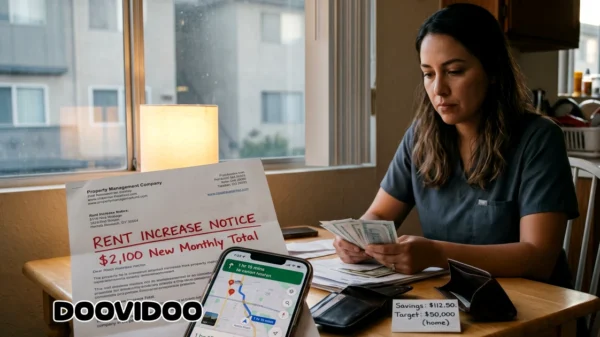
Rent does not offer enough relief either. In many cities, renting is no longer a stage before buying. It is a permanent condition. For millions of households, the monthly payment absorbs resources that once served to save, study, care for health, or start a family.
When a person spends 30, 40, or 50 percent of their income on housing, home becomes a burden. It no longer represents security. It represents pressure. If the lease also rises every year, that person lives with a constant threat: moving again.
The cultural consequence is deep. Homeownership is no longer a normal step into adulthood. Many people postpone relationships, children, businesses, studies, or moves because they cannot secure a stable address. Housing stops being the base of life and becomes a monthly calculation.
Van Life: Freedom for Some, Shelter for Others
Life in vans became popular as a symbol of freedom. People convert vans, small buses, or trucks into mobile homes. Folding bed, small kitchen, solar panels, portable internet, storage under the mattress, and maps of permitted parking spaces.
For some, van life is a choice. They work remotely, travel, reduce expenses, and prefer mobility over a mortgage. The vehicle becomes a compact and flexible home. There is no yard, but there is a road. There is no living room, but there is a landscape. There is no fixed address, but there is a sense of control.
For others, living in a vehicle is not a lifestyle. It is survival. Rent went up. Work is not enough. A divorce, illness, debt, or family emergency broke the balance. The vehicle appears as the last barrier before the street.
This difference matters. Not every person in a van is an influencer. Not every mobile life is an adventure. Some people have computers, work, and interior design. Others sleep in cars without a bathroom, without security, without refrigeration, and with fear of fines or theft.
Vehicle life redefines home in an extreme way. The bed is next to the steering wheel. The kitchen depends on limited water. The bathroom is found in gyms, gas stations, libraries, or parks. Privacy depends on curtains. Safety depends on where the vehicle is parked.
Home becomes mobile, but also vulnerable.
Safe Parking and Vehicle Housing
The rise of people living in vehicles forced some cities to respond with safe parking programs. These spaces offer authorized places to sleep in cars or RVs, with access to bathrooms, showers, laundry, social workers, or connections to housing services.
Safe parking recognizes an uncomfortable reality: the vehicle already functions as housing for many people. It is not a final solution, but it reduces risks. Sleeping in a supervised lot is different from sleeping on a dark street, under threat of towing or violence.
Studies on vehicle residency in Los Angeles show that people living in vehicles do not always match the traditional image of homelessness. Compared with those living in tents or public spaces, they are more likely to be women, live in larger households with children, and not be chronically homeless.
That difference forces policy changes. A family in a vehicle does not need the same response as a person living alone on a sidewalk. It needs safety, access to services, protection for children, and a real path toward permanent housing.
The vehicle as home reveals the failure of the formal market. No one should depend on a fine, a tow truck, or a broken window to know whether they will have a roof that night.
Coliving: Community or Fragmented Rent
Coliving is growing in cities where traditional rent is too expensive for one person alone. The model combines private rooms with common spaces: kitchen, living room, laundry, coworking area, terrace, events, and shared services. The promise is simple: pay less than for a full apartment and gain community.
For students, young workers, internal migrants, and professionals newly arrived in a city, coliving can solve real problems. It does not require buying furniture. It reduces paperwork. It includes services. It allows people to meet others. It works for those who need flexibility.
But coliving also has a harsher side. In tight markets, some companies sell small rooms at high prices because rent per square foot generates more income than a traditional home. The user does not rent a full home. They rent a portion. The bathroom, kitchen, living room, and even intimacy are negotiated.
In Seoul, the coliving market shows this tension. The city has seen a strong increase in units and demand, driven by one person households, high prices, and difficulty entering the housing market. But criticism has also emerged over high rents, narrow private spaces, and problems in common areas.
Coliving redefines home as a service. The person pays for a bed, connection, programmed community, and maintenance. Coexistence no longer depends only on family or friendship. It becomes a real estate product.
Extreme Coliving and Minimal Spaces
Extreme coliving takes this logic further. Rooms the size of a capsule. Beds in modules. Overcrowded shared kitchens. Bathrooms shared by dozens of residents. Flexible contracts, but little privacy. Spaces designed for sleeping, not living.
These formats appear in cities where land is expensive and demand exceeds supply. They also respond to a generation that accepts fewer square feet in exchange for location. Living near work, college, or transportation becomes more valuable than having a private living room.
The problem is that home is not only spatial efficiency. A person needs rest, privacy, silence, the possibility of getting sick, space for relationships, emotional safety, and the ability to keep memories. When home is reduced to a bed and WiFi, something is lost.
Minimal housing can help in an emergency or short stage. But if it becomes a permanent model for working adults, it shows a reduction of expectations. Society stops asking why housing is inaccessible and begins teaching people to live with less space, less privacy, and less stability.
The Unconventional Shared Home
Beyond van life and coliving, other arrangements are growing. Adults sharing a house with friends to divide rent. Separated couples who keep living under the same roof because they cannot afford two homes. Multigenerational families coming back together. Older adults renting out rooms. Workers moving between a couch, a temporary room, and a vehicle. Communities buying or renting collectively.
These arrangements are not new, but their meaning has changed. Before, they could be seen as transitions. Now, for many, they are structural strategies.
The shared home has advantages. It lowers costs. It divides tasks. It creates company. It fights loneliness. It makes it possible to live in areas where one person alone could not enter. But it can also create conflicts over noise, cleaning, schedules, visitors, money, care, and privacy.
Shared housing works when there are clear rules and balanced power. It fails when one person depends too much on another, when there is no contract, when the owner lives inside and controls everything, or when need forces people to accept undignified conditions.
The Loss of a Fixed Address
Having a home also means having an address. Receiving mail. Registering for services. Opening a bank account. Applying for work. Enrolling children in school. Voting. Accessing health care. Keeping documents. Proving residence.
When a person lives in a vehicle, temporary coliving, a borrowed couch, or an informal room, the address becomes unstable. That instability produces invisible effects. It makes formal employment harder to secure. It complicates paperwork. It increases stress. It reduces a sense of belonging.
Home is not only a roof. It is an administrative platform. Without a stable address, life becomes harder to prove before the state and the market.
For that reason, unaffordable housing does not affect only comfort. It affects practical citizenship.
Community Over Property
One of the strongest ideas of this new stage is that home is separating from property. For previous generations, home and homeownership seemed connected. For many younger people, home can be a shared room, a network of friends, a van, a cooperative, a coliving building, or a mobile community.
This separation has cultural power. It allows people to imagine less individualistic ways of living. Housing cooperatives, intergenerational communities, shared housing projects, and mutual aid models question the idea that each person must solve domestic life alone.
But there is also risk. Companies can use the language of community to sell less space for more money. They can turn the lack of affordable housing into a business opportunity. They can call precarity flexibility.
Real community is not a weekly event in the common room. It is support, trust, fair rules, permanence, and the ability to care for someone when they become ill or lose income.
The Future of Home
The redefinition of home will continue as long as traditional housing remains inaccessible. Van life, coliving, minimal spaces, and shared homes will not disappear. Some will be chosen. Others will be imposed by necessity.
The political question is what kind of response society accepts. If it becomes normal for workers to live in vehicles, for adults to pay for capsules, or for families to share overcrowded spaces, the problem becomes background scenery. If it is understood as a symptom of crisis, then home returns to the center of public debate.
The future needs more affordable housing, stable rents, tenant protections, well located construction, transportation, transition programs, and cooperative models. It also needs to recognize that alternative solutions do not replace the right to live safely.
A home can be small. It can be shared. It can be mobile. But it must offer something basic: enough stability to build a life.
Unaffordable housing forced millions of people to redefine home. Some found freedom. Others found temporary shelter. Many found a way to resist. But no city should confuse adaptation with solution. Home cannot be reduced to surviving in the space that remains.
Sources used: Harvard Joint Center for Housing Studies reported in 2026 that housing costs continue to rise for owners and renters, while assistance remains insufficient. It also reported that in 2024 there were 22.7 million cost burdened renter households, equal to 49 percent of renters, and 12.1 million severely burdened households paying more than half of their income toward housing.
HUD reported that 771,480 people experienced homelessness on a single night in January 2024, the highest level recorded, and linked the increase to the affordable housing crisis, inflation, and stagnant wages. In 2025, HUD reported 745,652 people experiencing homelessness on a single night and 266,320 living unsheltered.
UCLA Lewis Center states that people living in vehicles are a growing and understudied population. In Los Angeles, vehicle residents are more likely to be women, live in larger households with children, and not be chronically homeless, compared with other unhoused people in public spaces.
RSQUARE Analytics reported that coliving houses in Seoul reached 7,371 units in the first quarter of 2025, with 4.7 times growth over nine years. It also noted median rents of 900,000 won, narrow private spaces, and demand driven by one person households and the high cost of entering the real estate market.