
























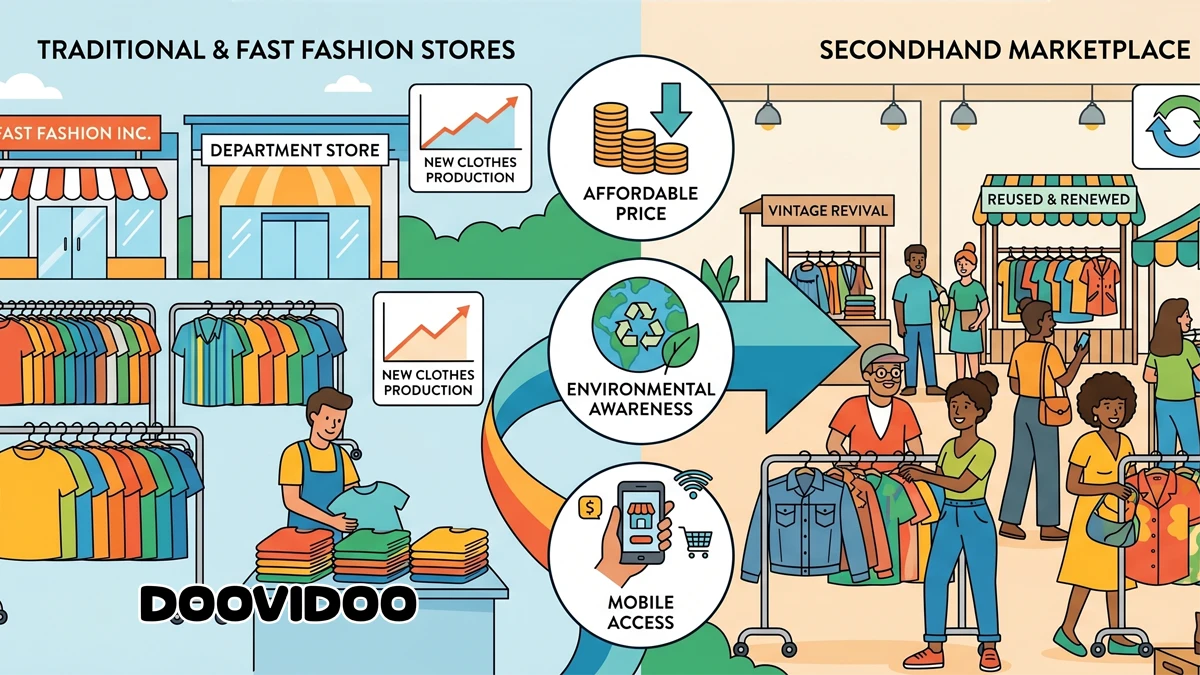
Secondhand is no longer a secondary purchase. Today it competes with traditional stores, fast fashion brands, and digital platforms. The shift responds to three clear forces: price, environmental awareness, and mobile access.
For years, buying used clothing was associated with charity shops, local markets, or financial need. Now textile resale is part of the digital economy. Vinted, Depop, ThredUp, Poshmark, eBay, and The RealReal turned the used closet into global inventory. A forgotten garment at home enters the market with a photo, a description, and a price. A buyer finds it from another state or country.
Growth shows a real shift in consumer behavior. Secondhand no longer works only as a cheaper alternative. It also helps people access better brands, reduce waste, and extend the life of garments that still hold value.
What Secondhand Means in Fashion
Secondhand refers to clothing, shoes, and accessories that already had a previous owner and return to the market. In fashion, this model includes vintage clothing, recent pieces in good condition, designer items, children’s clothing, footwear, handbags, and items with tags that were never worn.
The appeal starts with price. A new garment includes production, transportation, retail margin, marketing, and seasonality. A used garment already passed through that cycle. That is why its price often drops below the original value, even when the condition remains good.
The market also changed because of technology. Before, the buyer depended on what was available in a physical store. Now the buyer filters by size, brand, color, condition, and price. Search became more precise. Supply became wider. Trust grew through payment systems, buyer protection, reviews, and verification.
Textile Resale Platforms Are Growing
The numbers show that secondhand is no longer marginal. ThredUp projects that the global secondhand apparel market will reach 393 billion dollars by 2030. The company also states that this segment is growing faster than the overall apparel market.
Vinted reflects the same trend in Europe. The company reported 10.8 billion euros in gross merchandise value in 2025, with annual growth of 47 percent. Its revenue reached 1.1 billion euros. That figure confirms that consumer to consumer resale already operates at massive scale.
Depop is also gaining strength among younger buyers. In 2025, it reached close to 1 billion dollars in annual gross sales. The platform had 7 million active buyers and more than 3 million active sellers by the end of that year. Nearly 90 percent of its buyers were under 34.
The shift reached public statistics too. The U.S. Bureau of Labor Statistics added secondhand clothing to the Consumer Price Index in 2025. That decision shows that spending on used clothing now matters inside shopping habits.
Price: New Clothing Versus Used Clothing
Price is the first driver of secondhand. On digital platforms, the difference compared with new clothing appears fast. ThredUp promotes new or like-new items with discounts of up to 90 percent off estimated retail price. Poshmark highlights savings of up to 70 percent compared with store prices.
Savings change by brand, demand, condition, and season. A new 30 dollar T-shirt could have a used price near 9 dollars if a 70 percent discount applies. A new 120 dollar jacket could drop to 36 dollars under the same range. A designer piece with high demand holds more value and drops less in price.
Secondhand also allows people to buy better quality with the same budget. A person with 50 dollars faces two options. They can buy several new fast fashion pieces with lower durability materials. Or they can buy one used garment with better construction and a longer life.
Savings are not always automatic. In vintage clothing, limited editions, or luxury brands, the used price rises because of scarcity. Some pieces cost more than they did when they first entered the market. That is why the buyer needs to compare recent sales, review condition, and avoid impulse purchases.
Fast Fashion and Its Environmental Impact
Secondhand is gaining strength because fast fashion created a high environmental cost. The model of producing more, selling cheap, and renewing collections at high speed creates waste, water consumption, and emissions.
The United Nations Environment Programme reports that 92 million tons of textile waste are generated each year. That equals one garbage truck full of clothing sent to landfill or incineration every second.
The same organization estimates that the fashion and textile sector represents between 2 and 8 percent of global greenhouse gas emissions. It also consumes 215 trillion liters of water per year, equal to 86 million Olympic swimming pools.
The Ellen MacArthur Foundation describes the current fashion system as linear. Resources are extracted, garments are made, sold, worn briefly, and discarded. That model loses economic value and damages natural resources.
Buying secondhand does not solve the entire problem. But it extends the life of existing garments. Every garment that returns to the market reduces pressure to produce another one from zero. The benefit grows when a used purchase replaces a new purchase and does not add to excessive consumption.
Secondhand as a Response to Waste
The environmental value of secondhand lies in extending product life. A shirt that stays in circulation avoids ending up in the trash. A coat that passes to another owner keeps its material value. A repaired pair of shoes reduces waste.
The logic is simple. The most sustainable garment is often the one that already exists. But this idea requires discipline. Buying twenty used garments because they are cheap does not improve the problem. It changes the purchase channel, but keeps excess consumption.
Secondhand works best when it responds to a real need. A coat is missing. Children’s clothing is needed. A work shirt is needed. A dress is needed for an event. In those cases, buying used lowers spending and avoids extra production.
It also changes the relationship with the closet. The buyer learns to review fabrics, seams, zippers, stains, and wear. Quality matters again. The garment stops being disposable.
Why Young Buyers Purchase More Secondhand
Young buyers drive a large part of the growth. They seek price, personal style, and fast access. They also value pieces with less repetition. Secondhand offers items that do not appear in every store.
Depop built its strength on that logic. Its community blends fashion, identity, and resale. The seller does not upload just any garment. They present it with style, context, and visual identity. The buyer does not seek only savings. They seek a different piece.
Vinted responds to another profile. It makes person to person selling easier, with a practical and low cost approach. Many families sell children’s clothing, seasonal pieces, or garments that no longer fit their routine. The financial incentive is direct. You recover part of the money and free up space.
ThredUp works closer to a managed model. It receives garments, classifies them, photographs them, and sells them. This system reduces work for the seller. It also gives the buyer an experience closer to a traditional online store.
Trust, Authenticity, and Condition
Trust defines the success of secondhand. The buyer needs to know what they will receive. Size, measurements, wear, stains, materials, brand, and condition must appear clearly. A poor photo lowers conversion. An incomplete description increases complaints.
In luxury, authenticity is central. Handbags, shoes, and designer garments attract counterfeits. That is why platforms invest in verification, payment protection, and human review. A buyer pays more when they trust the piece.
Condition also changes the price. A garment with tags is worth more than a garment with signs of wear. A jacket with visible wear loses value. A handbag with original documentation holds its price better. Secondhand is not a uniform market. Each item counts as its own unit.
Risks in the Secondhand Market
Growth brings risks. The first is overpaying. Some used garments appear at prices close to original retail. This happens because of viral fashion, scarcity, or poor comparison. The buyer must review the new price, closed sales, and condition.
The second risk is buying without need. A low price encourages excess. The purchase feels responsible because it is used, but it still takes space and shipping resources.
The third risk is quality. A cheap garment in poor condition ends up in the trash fast. The savings disappear if it lasts for a short time. Inspection before buying is basic.
The fourth risk is logistics. Buying a low price used garment from very far away reduces part of the environmental benefit through transportation. It helps to prioritize nearby sellers when cost and availability allow it.
How to Buy Secondhand With Judgment
Buying secondhand requires a method. First, define what you need. Second, set a budget. Third, compare with the new price. Fourth, review condition. Fifth, verify measurements. Sixth, analyze the total cost with shipping and fees.
Size is not enough. Brands change cuts. A medium shirt in one brand does not equal another. Shoulder, chest, waist, and length measurements reduce mistakes.
It also helps to review materials. Thick cotton, wool, linen, leather, and well-built denim often last longer. Garments with firm seams and working zippers deserve more attention.
If you buy to resell, the rule changes. You need to study demand, brand, exit price, and sale speed. A cheap garment does not always leave profit. Listing time, commissions, and shipping count.
Secondhand and the Circular Economy
Secondhand supports a central idea of the circular economy: keeping products in circulation for longer. In fashion, this idea faces a strong challenge because the current system rewards volume, novelty, and low prices.
Resale platforms help change the flow. What once stayed stored or ended up in donation with no clear destination now finds a buyer. Used clothing gains price, visibility, and traceability.
Brands are also watching the change. Some launch resale, repair, or buyback programs. They do not do this only for sustainability. They also want to keep the customer relationship and participate in a market that used to remain outside their control.
The Future of Secondhand
Secondhand will keep growing because it solves concrete problems. It helps people spend less. It gives access to better brands. It reduces waste. It creates income for sellers. It fits mobile habits.
But its impact will depend on buyer behavior. If resale replaces new purchases, it adds environmental value. If it increases the total volume of garments purchased, the benefit falls.
The market needs transparency, better price data, authentication, efficient logistics, and consumer education. Used clothing no longer competes from the edges. It competes from the center of digital commerce.
Secondhand is not a passing trend. It is an economic and environmental response to a textile system that produced too much, sold too fast, and discarded too soon. The informed buyer has an advantage: they pay less, choose better, and reduce pressure on the planet.
Supporting data: ThredUp projects that the global secondhand apparel market will reach 393 billion dollars by 2030 and grow twice as fast as the overall apparel market. Vinted reported 10.8 billion euros in GMV in 2025, with annual growth of 47 percent. Depop reported close to 1 billion dollars in annual gross sales in 2025, 7 million active buyers, and more than 3 million active sellers.
For environmental impact, UNEP reports 92 million tons of textile waste per year, between 2 and 8 percent of global greenhouse gas emissions, and 215 trillion liters of water consumed by the sector. The Ellen MacArthur Foundation states that the equivalent of one garbage truck full of clothing is burned or landfilled every second.
For pricing, ThredUp promotes used or like-new clothing with discounts of up to 90 percent off estimated retail price, and Poshmark communicates savings of up to 70 percent compared with store prices. The U.S. Bureau of Labor Statistics added secondhand clothing to the CPI in 2025 because it now represents a growing segment within apparel consumption.