








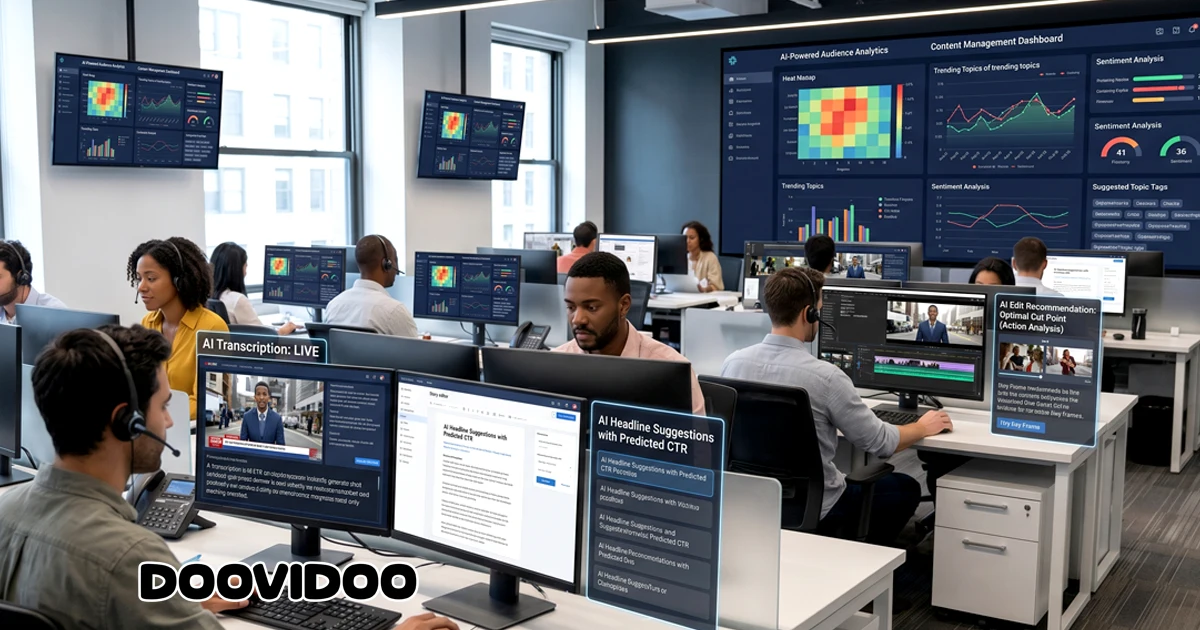
The relationship between AI and employment has already changed daily life inside newsrooms. Artificial intelligence is no longer a technical promise. It is now part of daily workflows. Today, it supports transcription, basic editing, data analysis, content management, audience measurement, and headline production.
This shift does not erase the role of the journalist. It changes it. AI accelerates processes. Human judgment decides what to publish, what to verify, what to correct, and what to reject.
In the media industry, this difference matters. A tool transcribes an interview. An editor detects context, contradictions, and legal risks. A system analyzes web traffic. A journalist interprets what the audience needs and what data is missing. Technology delivers speed. The profession delivers meaning.
For this reason, the debate over AI and employment should not focus on fear or enthusiasm. It should focus on skills, editorial control, ethics, training, and productivity.
What AI and Employment Mean in the Media Industry
The term AI and employment describes the impact of artificial intelligence on jobs, tasks, skills, and production models. In the media industry, this impact appears in three main areas.
The first area is the automation of repetitive tasks. This includes transcriptions, internal summaries, content tagging, grammar review, metadata entry, and news classification.
The second area is editorial support. AI helps review headlines, detect trends, organize databases, compare documents, and analyze audience metrics.
The third area is the transformation of professional profiles. Newsrooms no longer look only for writers, editors, or producers. They also need people who understand data, measurement dashboards, tool audits, and collaboration with technical teams.
This transformation does not move at the same pace in every company. Large media organizations integrate internal platforms. Smaller outlets test commercial tools. Independent journalists adopt transcription, editing, and analysis systems to save time.
AI Adoption in Newsrooms
Newsrooms integrate artificial intelligence systems to manage content faster. Interview transcription is one of the most common cases. A one-hour conversation once required manual work. Now a tool delivers a text base in minutes. The journalist reviews names, figures, quotes, and context.
Basic editing has also changed. Writing assistants detect errors, suggest headline versions, and help with SEO meta descriptions. This function helps teams with high publishing volume. An editor receives a first version. Then the editor adjusts tone, accuracy, and focus.
News curation has gained weight. AI tracks trends, groups topics, and detects changes in audience interest. This helps prioritize coverage. But the final decision requires editorial judgment. A trend does not always equal a relevant story. A viral topic does not always deserve the front page.
According to the International Labour Organization, the strongest impact of generative AI tends to complement tasks rather than replace entire occupations. The ILO study points to administrative work as one of the areas with the highest exposure. In that group, a large share of tasks shows growing automation or support.
That finding fits what happens in media. Many editorial support tasks become automated before core investigative work. AI processes text. The journalist decides relevance, sourcing, and responsibility.
Operational Changes in Journalistic Work
Artificial intelligence changes the journalist’s method. In the past, part of the day went into mechanical tasks. Listening to full interviews for transcription. Organizing data in tables. Reviewing files. Preparing headline options. Sorting topics by category. Today, several of these tasks move faster with technological support.
That time saving creates an opportunity. The journalist spends more hours on investigation, reporting, interviews, fact-checking, and critical editing. In a healthy newsroom, AI does not push the journalist toward automatic production. It removes lower-value tasks and strengthens the work that requires judgment.
Verification gains importance. The faster information moves, the greater the risk of errors. Tools generate summaries, but they also fail. They confuse names. They mix dates. They invent connections. They omit nuance. For this reason, human control is not a small detail. It is the center of the process.
Critical editing also gains value. A grammatically correct text is not always good journalism. An attractive headline is not always fair. A piece optimized for traffic does not always inform well. The editor reviews intent, accuracy, balance, and potential harm.
AI and Employment: New Skills for Journalists
The impact of AI and employment appears clearly in the skills companies request. Today’s journalist needs to write well, interview well, and verify well. The journalist also needs to understand digital tools, data, SEO, analytics, and content management.
Training becomes part of the job. Companies invest in internal workshops. Teams learn to write clear instructions, review outputs, detect errors, and protect sensitive information. Training no longer belongs only to technical departments.
Hybrid profiles gain space. A writer who understands SEO brings more value. An editor who interprets metrics makes better publishing decisions. A producer who manages databases works with greater accuracy. A journalist who audits AI reduces the risk of errors and bias.
The World Economic Forum reported in its Future of Jobs 2025 report that AI and big data are among the fastest-growing skills. It also stated that many employers plan to train their teams before 2030. The message for media companies is direct. Job stability will depend more on adaptation, judgment, and continuous learning.
The Role of Editors and Writers
Editors report greater efficiency when working with databases, long documents, and metrics. A tool helps find patterns across hundreds of pages. It also helps compare document versions, detect changes, and organize topics.
Writers integrate assistants to improve headlines, subheadings, and metadata. This strengthens SEO when human supervision exists. AI suggests options. The writer chooses the clearest and most accurate version, aligned with search intent.
In articles about AI and employment, for example, a tool identifies related terms such as workplace automation, artificial intelligence at work, future of jobs, digital skills, and labor transformation. The editor decides which terms belong in the article and which ones stay out.
Web traffic management has also changed. Newsrooms review data in real time. They know which headline performs, which section keeps readers, and which topic loses interest. AI helps read that data faster. But editorial strategy should not follow traffic alone. A media outlet must also cover relevant topics even when they do not produce the highest click volume.
Automation Without Losing Human Judgment
Automation reduces production time. This advantage matters in media organizations that compete for speed. But speed without judgment damages trust.
AI identifies consumption patterns. It detects reading times. It suggests formats. It helps personalize content. That personalization improves the reader experience when clear limits exist. But it also creates risks. A media outlet should not trap the user in repeated topics or lower editorial standards to keep visits.
Human judgment protects quality. A journalist knows when a source has a conflict of interest. An editor recognizes weak data. A legal team reviews sensitive accusations. An editorial director decides whether coverage serves the public interest.
AI does not replace that chain of responsibility. It makes it more necessary.
Labor Challenges of Artificial Intelligence
Automation raises concrete questions. Which tasks remain human. Which tasks move to tools. Which profiles need training. Which jobs lose demand. Which new functions appear inside newsrooms.
Administrative areas show high exposure. Support tasks, classification, archiving, and text processing already face growing automation. In media, this affects editorial assistants, first-line copy editors, content managers, and repetitive production teams.
But impact does not mean immediate disappearance. Many functions change shape. A copy editor reviews AI outputs. An editorial assistant coordinates automated workflows. A producer monitors quality and consistency. An editor defines internal rules.
Adaptability matters more than the formal job title. The professional who learns to work with AI keeps an advantage. The one who ignores the shift loses space.
Risks for Media and Public Trust
AI brings efficiency, but also risks. The first risk is the publication of errors. A poorly supervised system delivers false data with a confident tone. If a media outlet publishes without review, it loses trust.
The second risk is lack of transparency. The reader should know when a piece includes relevant automated support. Trust requires clear rules inside the newsroom.
The third risk is excessive dependence. If every outlet follows the same tools, texts start to look alike. The editorial voice weakens. Coverage loses depth. Original investigation loses space.
The fourth risk is labor-related. A poorly managed company treats AI as an excuse to reduce staff without improving processes. That decision lowers costs for a time, but it harms quality, reputation, and investigative capacity.
AI and Employment in Media: A Real Opportunity
The opportunity exists when AI enters the workflow with method. A newsroom gains efficiency when it automates repetitive tasks, trains its staff, and maintains clear standards. It also gains capacity to analyze documents, detect patterns, and respond faster to the audience.
An independent journalist also gains room to work. AI lowers the cost of interview transcription. It organizes notes. It reviews structure. It analyzes search trends. It prepares headline drafts. That recovered time goes into reporting, calls, document reading, and editing.
AI improves workflow when it occupies the right place. It should not direct the agenda. It should not replace verification. It should not sign off on editorial judgment. It should serve as a tool under supervision.
The Future of Work in Newsrooms
The future of AI and employment in the media will not be total replacement. It will be a redistribution of tasks. Mechanical work will lose value. Editorial, technical, and analytical skills will gain weight.
Media companies will need journalists with investigative ability, tool fluency, professional ethics, and publishing judgment. They will also need editors who design safe processes. Training will no longer be an extra benefit. It will become a condition for staying relevant.
The central question for each professional is practical. Which part of your work does a machine repeat efficiently. Which part requires your experience, your judgment, and your responsibility. The first part should be automated with control. The second should be strengthened.
AI and employment is no longer a future topic. It is a daily reality inside newsrooms. Artificial intelligence accelerates tasks. The journalist maintains quality. The company that understands this difference will build better processes. The professional who learns to work with these tools will hold greater value in the labor market.
Sources consulted: the International Labour Organization indicates that generative AI has a stronger complementary effect than a full replacement effect, with high exposure in administrative work. Reuters Institute reported that 56 percent of journalists in the United Kingdom employ AI professionally at least once per week. The World Economic Forum projects that AI and big data will rank among the fastest-growing skills toward 2030.