The “death” of the human voice no longer sounds like science fiction. It sounds like a tour announced after death. Like a voice isolated by software. Like an avatar that sings every night without fatigue. Like a contract where an artist’s name, image, catalog, and vocal identity stop belonging to the body that created them.
The music industry has always sold memory. Remastered records, reissues, documentaries, T-shirts, biographies, films, anniversary vinyl. But something has changed. Now it is no longer selling only the archive. It is selling the possibility of reactivating the artist. Making them sing again. Placing them in front of an audience. Crossing them with technology. Turning their absence into spectacle.
The new business of the “digital ghost” treats the voice like oil. A resource that can be extracted, refined, licensed, and exploited after a person retires, ages, or dies. The voice, once understood as physical presence, breath, error, throat, and time, becomes a financial asset.
The thesis is harsh: music is moving from being a living human experience to a product that no longer needs the artist to keep generating dividends.
The Stage Without a Body
For centuries, live music depended on a basic truth: someone was there. A singer could fail, cry, go off-key, sweat, get sick, forget a lyric, or change a phrase because the audience that night was different. That fragility was part of the value.
Tours based on holograms, avatars, and AI-processed voices break that relationship. The show keeps the shape of a concert, but empties part of its risk. The artist does not arrive late. They do not lose their voice. They do not age further. They do not negotiate. They do not cancel from exhaustion. They do not get paid as a living body. Their presence becomes programmable.
ABBA Voyage marked a turning point because it showed that audiences are willing to pay for an artificial presence if the spectacle has scale, control, and authorization from living artists. Its “ABBAtars” are not presented as a technological accident. They are presented as a new form of musical residency. The band is not physically onstage, but its young image, music, and collective memory produce a profitable and emotional experience.
That case is less dark because the members of ABBA participated in the decision. But it also opened a door. If a living group can perform as a permanent digital version, what stops the industry from trying the same with dead, sick, or retired artists.
The answer is no longer technical. It is ethical.
Whitney, Elvis, and Commercial Resurrection
Whitney Houston died in 2012. Even so, her voice returned to stage projects driven by technology. First came a hologram tour that generated criticism and debate. Then came a proposal without a central hologram, focused on isolating her original voice through AI tools and presenting it with a live orchestra.
The official argument is usually respect. Tribute. Preservation. Celebration. Access for new generations. It is an understandable defense. Many fans never had the chance to see Whitney live. Many want to hear her voice in a new context. Technology makes it possible to recover mixed recordings, separate tracks, and rebuild a sound experience with higher quality.
But the discomfort remains. The artist is not there to decide how she wants to be heard now. She cannot reject a production. She cannot correct the staging. She cannot say that a song no longer represents her. She cannot refuse to be used as a vehicle for profitable nostalgia.
Elvis Presley occupies another place in the same conversation. His image has operated for decades as a parallel industry: suits, impersonators, museums, films, licenses, spectacles. With immersive proposals based on AI, projection, and archival material, the business seeks to bring audiences closer to an Elvis who no longer exists. The problem is not only whether the show moves people. The problem is who manages the return and under what limits.
Death, in this model, does not close a career. It opens a second stage of exploitation.
The Voice as Property
The industry has already understood that a music catalog is not enough. Songs matter, but identity matters more. A melody can have value. A recognizable voice has immediate emotional power. If AI reproduces timbre, accent, breath, vibrato, and style, it is not creating only sound. It is invoking a person.
That is why recent agreements between major labels and AI-generated music platforms are so important. Universal, Warner, Sony, and new technology companies are trying to build models where artists and composers authorize the use of names, images, voices, likenesses, compositions, and styles to create new music. In theory, this protects consent and compensation. In practice, it also confirms that vocal identity has become a market.
Before, an artist sold songs. Then they sold catalogs. Now they sell the possibility of simulation.
That change alters the question of ownership. Does the voice belong to the artist as part of their body? Does it belong to a record label if it appears in licensed recordings? Does it belong to an estate after death? Can a family authorize uses the artist would have rejected? Can a company buy enough catalog to train a statistical version of someone’s style?
The law is still running behind the technology. The NO FAKES Act in the United States seeks to protect voice, image, and identity from unauthorized digital replicas. The very existence of that legislation shows the size of the problem. The voice is no longer only expression. It is exploitable data.
The Digital Ghost as the New Oil
The comparison with oil seems exaggerated until the business is examined. Oil is not valuable because it is beautiful. It is valuable because it fuels systems. The digital voice works the same way. It fuels tours, immersive experiences, advertisements, impossible duets, translated versions, new songs, video games, films, AI platforms, and personalized content.
A dead artist no longer needs a schedule. An avatar does not negotiate a nightly salary. A generated voice does not age. A digital catalog does not get tired. For investors, that model is irresistible. It reduces human uncertainty and expands the possibility of continuous exploitation.
The industry has always wanted commercial immortality. AI gave it tools.
The key word is scalability. A living singer performs in one place at a time. A digital ghost can appear in multiple markets, languages, and formats. It can sing for audiences that never bought a physical record. It can adapt to new platforms. It can produce content without passing through the exhaustion of the body.
The dehumanization of the stage does not happen all at once. It happens when the business discovers that human presence is the least efficient component of the musical product.
Consent Before and After Death
The ethics change when the artist is alive and participates. If ABBA decides to become avatars, there is consent. If a veteran singer sells the rights to use their voice for future releases, there is agency. The problem is whether that agency is limited by opaque contracts, financial pressure, or an industry that presents digital immortality as the only way to remain relevant.
There is also the opposite case: artists who reject that possibility. Dolly Parton said she did not want to live as an AI hologram after death. Her statement matters because it draws a clear boundary: not every memory should become a simulation.
The posthumous case is more delicate. An estate can have legal rights, but it does not always have absolute moral authority. Families, managers, labels, investment funds, and technology companies can have interests different from the artist’s wishes. And often, the public does not know what that person actually said or requested.
The basic ethical question should be simple: did the artist want this in an explicit, informed, and specific way?
Owning recordings is not enough. Managing a brand is not enough. Saying that fans want it is not enough. Vocal identity is not a T-shirt. It is an extension of the person.
The Public Participates Too
The industry does not create digital ghosts alone. It creates them because there is an audience. The public buys tickets, shares videos, cries in front of a projection, listens to posthumous songs, celebrates impossible duets, and asks for “one last time” from artists who can no longer give it.
That demand should not be mocked. Grief needs rituals. Music connects generations. A dead voice can accompany someone throughout their life. Wanting to hear it again is human.
But desire can also be exploited. Nostalgia is a vulnerable emotion. A company that sells the impossible return of an artist is not selling only music. It is selling a temporary suspension of death. It is selling the fantasy that nothing was fully lost.
That is the danger. The digital ghost can console. It can also interrupt grief. It can honor memory. It can also turn it into a theme park.
The difference lies in consent, context, transparency, and limits.
Eternal Labor
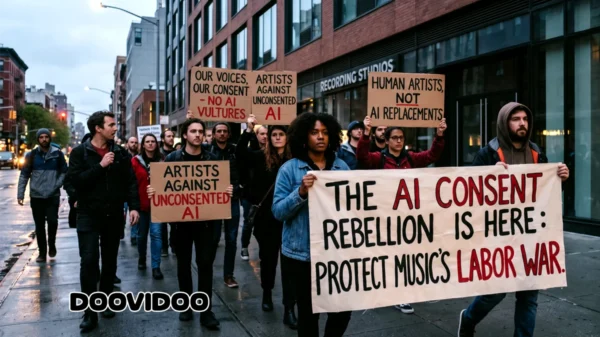
The central question is unsettling: is it ethical for an artist to keep “working” after retirement or death?
If the artist left clear and controlled instructions, the answer can be yes. If the technology serves to restore damaged archives, improve sound, or allow educational access, it can also have value. The problem appears when working becomes a financial sentence. When death does not free the body from the obligation to produce. When the voice keeps generating revenue for companies that will never have to look the artist in the eye.
Music has always had exploitation. Abusive contracts, predatory managers, labels that controlled masters, exhausting tours, unfair royalties. AI does not invent the problem. It automates it.
Before, an artist could fight for their catalog. Now they must fight for their ghost.
The Future of the Human Voice
The “death” of the human voice does not mean we will stop listening to living singers. It means the human voice will no longer be treated only as presence. It will be treated as license, model, dataset, replica, insurance, inherited asset, and scalable product.
That will change how we value a real concert. Seeing someone alive, vulnerable, and present may become more important. Or maybe more expensive. Authenticity could become a luxury. The phrase “no AI” could turn into a value label, like “organic” or “handmade.”
It will also change how we think about artistic inheritance. Musicians’ wills will have to include clauses about voice, image, avatars, holograms, model training, synthetic translations, and posthumous duets. Death will no longer be only a family matter. It will be an intellectual property matter.
The industry needs rules before the market normalizes the irreversible. Verifiable consent. Fair compensation. The right to refuse. Time limits. Clear labeling. Posthumous protection. Participation from heirs, but also respect for the artist’s instructions. And above all, a firm distinction between preservation and exploitation.
Silence Is Also a Right
Not every artist must sing forever. Not every voice must return. Not every technology that moves people deserves to be used. The music industry needs to accept an idea capitalism hates: some things end.
The human voice has value because it belongs to a finite body. Because it changes with age. Because it breaks. Because it gets tired. Because it breathes. Because it carries history. When we turn that voice into a perpetual asset, we gain availability, but we lose death. And without death, memory is also deformed.
The “death” of the human voice will not be a sudden blackout. It will be an elegant, expensive, sentimental transition. A hologram here. An isolated voice there. An AI contract. A posthumous duet. An eternal tour. A young avatar of someone who can no longer consent.
The digital ghost business promises immortality. But perhaps what it sells is something else: an industry incapable of letting its dead rest.
Music does not need to kill the human voice to survive. It needs to remember that a voice is not only sound. It is a life passing through a throat. When that life is no longer there, silence should also have value.
Sources used: ABBA Voyage reported that since opening in 2022 it generated £2.06 billion in economic activity in the United Kingdom and supported 9,739 annual jobs, an indicator of the commercial scale already reached by authorized avatar concerts.
Warner Music Group announced in 2025 a partnership with Suno in which artists and songwriters would have control over whether their names, images, voices, likenesses, and compositions are used in AI-generated music; Universal Music Group also announced an agreement with Udio for an AI platform trained on authorized music.
The reintroduction of the NO FAKES Act in 2026 seeks to protect voice, image, and identity from AI-generated digital replicas, and its sponsors present it as a response to the proliferation of deepfakes and voice clones.
TechRadar and Popular Mechanics reported that The Voice of Whitney: A Symphonic Celebration uses AI to isolate Whitney Houston’s original voice from mixed recordings and present it with an orchestra, a case that separates vocal restoration from hologram performance, while keeping the debate over posthumous presentations alive.
KISS sold its catalog, brand, and IP to Pophouse in a deal estimated at more than 300 million dollars, with plans for digital avatar concerts, while reports on Elvis Evolution show that immersive experiences with deceased figures also face criticism over expectations, working conditions, and authenticity.